
(spoilers.)
I’m generally very bad at picking up on subtext. With most novels, it usually takes me a few looks at other people’s reviews before I can fully appreciate what the book is about. Films are somewhat easier because I understand visual composition better than literary, but if I ever want to feel comfortable discussing them with other people, I had better look at that Wikipedia page. Music? Forget about it. I’m frequently pulling up Genius before the album is even over.
As a writer and storyteller myself, it’s a pretty miserable way to go through life. I always try to make sense of fiction before I look up the official explanation (like I did here), but when I accept defeat and open up that plot summary, I feel nostalgic for high school English classes where I had an authority figure to explain fiction to me.
Superhero movies are generally exempt from this because subtext is usually minimal, obvious or absent entirely. So as you might expect, when I left Superman with my brother on Friday night, I wasn’t exactly rushing to open Wikipedia.
But that’s not to say Superman was without any subtext— it actually has a lot. I was just pleased to find that the metaphor was completely unsubtle, so I understood it immediately. In fact, I believe that by the end of the movie, it would be incredibly difficult for anybody who reads the news to walk out of the theater and not have noticed any of the double meanings.
Below is what I noticed from my single viewing of the movie. You can read it if you want or just take my word for it.
THE REASONING
Early on, it’s apparent Superman himself symbolizes immigrants. His backstory as a refugee from a dead planet sent to help his adopted homeland makes it simple enough to understand. So when Superman gives himself up for questioning to the government, he is shoved to the ground and told “Aliens don’t have rights,” which neatly expounds on the original point. Thus, the extradimensional prison to which Lex Luthor takes him naturally prompts thoughts of similar legally tenuous prisons in the news today, like the Terrorism Confinement Center in El Salvador.
Superman gave himself up because Luthor decoded a message from his Kryptonian parents, instructing him to take over the planet and rebuild Kryptonian culture using human women as breeding stock. Luthor uses this to accuse Superman of plotting global conquest with an army of polygamist children, in a manner reminiscent of President Trump and other populist demagogues labeling immigrants as rapists, and of “Great Replacement” conspiracy theories. Unfortunately, I feel like this plot point undermines the film’s sympathetic portrayal of immigrants, and it may be connected to why the Superman-as-migrant metaphor disappears in the third act.
Luthor himself is an arms contractor shown to have free access to the biometric data of ordinary Americans and to own a prison in a pocket dimension where he can freely incarcerate anybody he doesn’t like, only accessible by portals that threatensthe fabric of reality every time they’re opened. By my calculation, this makes him about 70% Elon Musk and 20% Peter Thiel with the remaining share going to a generalized average of the owning class that profits from either climate change and private prisons.
The secondary antagonist is Vasil Ghurkos, the president of Boravia, an ally of the United States with a stated desire to invade the neighboring country of Jarhanpur. Ghurkos says he wants to liberate the people of Jarhanpur, which is reminiscent of Vladimir Putin’s pledge to denazify Ukraine, but he diverges from Putin in some notable ways.
For one, Boravia is an ally to the United States. And compared to Russia and Ukraine, the conflict between Boravia and Jarhanpur is very asymmetrical. Villagers with shovels and pitchforks are the only resistance shown to the Boravian incursion. With this in mind, the viewer could plausibly draw a very different conclusion: Ghurkos represents Benjamin Netanyahu.
The idea of Hollywood spending $200 million on a film where the president of Israel is flown up and killed via fall damage by a winged Dora the Explorer is far-fetched, so I think the Putin metaphor was more likely to be James Gunn’s intention. Still, all of this is to show just how transparent the political metaphors are. I’ll list a few more in bullet points:
- Superman is shown to be friends with another immigrant, a falafel vendor named Mali.
- Lex Luthor goes on a talk show multiple times with a host whose cadence and countenance I thought could have been inspired by Tucker Carlson or Jesse Watters. Considering Lex’s politics and the talk show’s role in the narrative, I think it’s likely the actor and/or director based the character off of them.
- In Luthor’s pocket universe, he shows Superman his personal army of monkeys with keyboards, consigned to perpetually posting anti-Superman ragebait online. In the context of Luthor’s alliance with Ghurkos, this is probably a reference to the popular image of the Russian social media bot farm, which look about the same, but with fewer monkeys.
- In a celebration of the power of journalism to hold the powerful accountable, Luthor’s reputation and fortune are destroyed by a Daily Planet report on his intentions to take over half of Boravia. As a result of the report, Luthor is arrested by the US government after Superman wipes out his private army. If only it were that easy.
- My brother thinks Green Lantern and the Justice Gang, with their noble intentions unsubstantiated by any real conviction, are meant to represent Chuck Schumer and the centrist Democrats. I personally think he’s smoking crack.
This infodump, extracted not from a college lecture or the analysis section of a Wikipedia page but my own stream of consciousness, shows Superman’s ultimate subversion of the genre. Instead of obfuscating its message in high-minded terms and leaving its interpretation to the video essayists, James Gunn spells out his metaphor in stark terms that any college-educated idiot can understand.
This may seem like a bold abuse of platform, with Gunn inserting woke politics into an apolitical superhero movie, but Superman has been written like this for decades. In Action Comics #22 and #23, Superman fights the forces of Galonia, a fictional country that invades the lesser nation of Toran. The comics were published in the spring of 1940, months after Germany invaded Poland. They were written and penciled by Jerry Siegel and Joe Shuster, Superman’s co-creators, both of whom were Jewish.
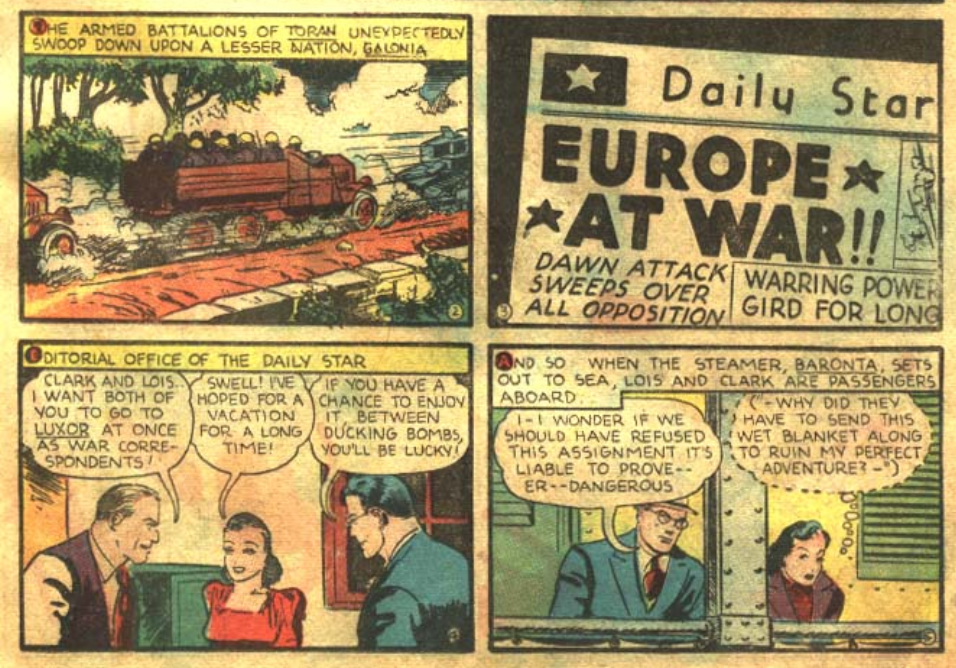
It’s not as ostentatious as when Captain America punched Hitler, but it predated it by about a year. So in a sense, Gunn’s movie is upholding the tradition of using superheroes as moral exemplars as a means of influencing public opinion, which is interesting to me because I can’t remember the MCU doing anything like that. At least, not before everyone stopped watching it.
I think that going forward, screenwriters should follow Gunn’s example. Writing mind-numbingly simple metaphors like Siegel and Shuster did is probably the most effective way of inspiring empathy in your audience, which I think is very important in this case because a lot of kids and teens are going to be watching Superman. Hopefully, America’s wokest English teachers will seize this opportunity to show drooling brainrotted Gen Alpha why media literacy is useful.
Maybe I should just start watching movies for adolescents and start writing essays about the hidden political messaging of The Hunger Games or some shit. After all, Superman saved me a lot of time looking at Wikipedia. ◼
 Ben Ackman's Photography Website